
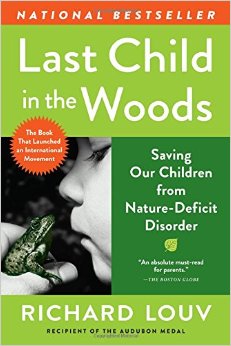
Last Child in the Woods
Saving our Children from Nature-Deficit Disorder
by: Richard Louv
Download AnnotationsHere’s the whole book-
Taking kids out of nature is not good for them or for the future of our society.
Louv suggests we are creating ‘nature-defecit disorder in our kids, to all of our peril. Our
society has pulled them out of nature due to time constraints and our own fear. We need
to re-create nature-based experiences, create a nature-child reunion, with unstructured
time, for kids to connect to nature- it is good for them in a host of ways.
Intro
P. 1 Today, kids are aware of the global threats to the environment- but their
physical contact, their intimacy with nature, is fading. That’s exactly the opposite
of how it was when I was a child.
Part 1: The New Relationship between Children and Nature
1) Gifts of Nature
P. 7- Unlike television, nature does not steal time, it amplifies it.
P. 10. The woods were my Ritalin. Nature calmed me, focused me, and yet
excited my senses.
P.10. Paul, a 4th grader in San Diego “I like to play indoors better, ‘cause that’s
where all the electrical outlets are.”
P. 14. Parents, educators, other adults, institutions- the culture itself- may say one
thing to children about nature’s gifts, but so many of our actions and messages-
especially the ones we cannot hear ourselves deliver- are different. And children
hear very well.
2)The Third Frontier
P. 15 Being in nature (used to be) about doing something, about direct experience,
not about being a spectator
P. 19 Baby boomers-those born between 1946 and 1964- may constitute the last
generation of Americans to share an intimate, familial attachment to the land and
water. The familial and cultural linkage to faming is disappearing.
Kids now inhabit the “3rd frontier” (the first being the western utilitarian view of
the land, the second being the family farm and romanticism of nature), which is
marked by 5 trends: a severance of public and private mind from our food’s
origins; a disappearing line between human, machines, and other animals; an
increasingly intellectual understanding of our relationship with other animals; the
invasion of our cities by wild animals; and the rise of a new kind of suburban
form.
3) The Criminalization of Natural Play
It used to be tree houses and time in nature…then due to tightened regulations
and fears, it became basketball hoops in the driveways..but that violated
covenants…so indoors went the kids and ‘game boys and sega became their
imagination’
P. 28. Many parents and kids now believe outdoor play is verboten even when it is
not; perception is 9/10ths of the law
Pl 31 Copius studies show a reduced amount of leisure time experienced by
modern families, more time in front of the tv and computer, and growing obesity P. 33. Another British study discovered that average 8 year olds were better able
to identify characters from the Japanese card trading game Pokemon than native
species in the community where they lived.
P. 34 University of Maryland study reports that children’s free play and
discretionary time in a typical week declined a total of 9 hours over a 25 year
period.
P. 35 these have been called ‘containerized kids’ as they spend more and more
time in car seats, high chairs, and even baby seats for watching tv. ….creating ‘the
physical restriction of childhood’
P. 36. The term Nature defecit disorder describes the human costs of alienation
from nature, among them: diminished use of the senses, attention difficulties, and
higher rates of physical and emotional illnesses.
Part II: Why the Young (and the rest of us) Need Nature
4) Climbing the tree of health
P. 40 (perhaps a goal for our students)…She filled 15 notebooks with pressed
plants, rainfall measurements, and of the species that live here.
P. 44 The DSM (psychological manual) lists many dysfunctions having to do with
sexuality, but not one about relationship to environment
5)A life of the senses: Nature vs the know it all state of mind
P. 59 As a matter of fact, our great-grandfathers, who ‘never went anywhere’ , in
actuality have had more experience with the world than we have, who have seen
everything.
P. 62 Why do so many Americans say they want children to watch TV less, yet
continue to expand the opportunities for them to watch it/
P. 64. We have seen a rise of ‘cultural autism’…There is something wrong with a
society that spends so much money, as well as countless hours of human effort- to
make the least dregs of processed information available to everyone everywhere
and yet does little or nothing to help us explore the world for ourselves
P. 66 Children live through their senses. Sensory experiences link the child’s
exterior world with their interior…..As we grow more separate from nature, we
continue to separate from one another physically.
P. 67 We are creatures identified by what we do with our hands…Primates studies
also show that physical touch is essential to the peace-making process.
P. 70 The young don’t demand dramatic adventures or vacations in Africa. They
need only a taste, a sight, a sound, a touch to reconnect with that receding world
of the senses.
6) The 8th Intelligence
Gardner posed originally, 7 intelligences, then added an 8th intelligence,
‘naturalist intelligence’. This could include:
o Having keen senses
o Likes to be outside or engaging outside activities
o Easily notices patterns in surroundings
o Interested in and care about animals or plants
Discussion of how treehouses used to be common place, and how ‘through it we
learned to trust ourselves and our abilities’ p. 81
7) The Genius of Childhood: How nature Nurtures Creativity P. 88 Swedish studies found that children on asphalt playgrounds had play that
was much more interrupted; they played in short segments. But in more natural
playgrounds, children invented whole sagas that they carried from day to day-
making and collecting meaning.
P. 88 Studies show that children in more nature based kindergartens were found
to be more alert, better at using their bodies, and significantly more likely to
create their own games.
P. 88 Researchers have also observed that when children played in an
environment dominated by play structures rather than natural elements, they
established their social hierarchy through physical competence. After an open
grassy area was planted with shrubs, the quality of play was very different.
Children used more fantasy play, and their social standing became based less on
physical abilities and more on language skills, creativity, and inventiveness. In
other words, the more creative children emerged as leaders in natural play areas.
P. 92 Nature experiences help children understand the realities of natural systems
through primary experience. They demonstrate natural principles such as
networks, cycles, and evolutionary processes. They teach that nature is a uniquely
regenerative process.
P. 95 Transcendent childhood experiences in nature were never reported when a
child did not enjoy freedom within an alluring natural or urban environment.
These don’t require spectacular scenery, but could be experienced in simple
environments or during freedom as brief as an escape into nature during a school
outing
8) Nature-defecit disorder and the restorative environment
P. 99 ‘lifers at Leavenworth get more time in the exercise yard’ than school kids
today, as nearly 40% of American elementary schools either eliminate or were
considering eliminating recess.
P. 101 Approximately 90% of young people placed on medication- often at the
suggestion of school officials- are boys. Between 1990 and 1995, US spending on
stimulants such as Ritalin, increased 600%. Between 2000 and 2003, spending on
ADHD for preschoolers increased 369 percent.
P. 102 As recently as 1950’s, most families still had some kind of agricultural
connection.
P. 103/4 Students today may be experiencing ‘directed-attention fatigue’ created
by too much directed attention. If you can find an environment where the
attention is automatic, you allow directed attention to rest. And that means an
environment that’s strong on fascination.
P. 106 Activities that left ADD children in worse shape were far more likely to
occur indoors or outdoors in spaces devoid of greenery. Activities in natural, green
settings were far more likely to leave ADD children better able to focus.
P. 110 If, as a growing body of evidence recommends, ‘contact with nature is as
important to children as good nutrition and adequate sleep’ then current trends in
children’s access to nature need to be addressed.
Part III The best of intentions: why johnnie and jeannie don’t play outside anymore
9) Time and Fear
P. 116 Our lives may be more productive, but less inventive. P. 117 from 1981-1997, the amount of time children spent in organized sports
increased by 27%. US Youth Soccer association went from 100,000 members in
1974 to 3 million today.
P. 118 A central concern is how parents model their own use of time- their
attitude about where time fits into their busy lives.
P. 119/20 Between 1981 and 2003, children lost over 9 hours of discretionary
time, spent less time in unstructured play, and doubled computer time. Between
1981 and 1997, studying increased by 20%. Television remains the most effective
thief of time. Children between 8-18 spend an average of 6.5 hours a day plugged
in electronically, that’s 45 hours a week. For parents, as internet use grows, adults
spend more time working for their employers at home, without cutting back their
hours in the office. Weekends are no longer for recreation, but for the undone
chores that pile up during the week. Researchers found that both parents cut back
on sleep to handle all their responsibilities.
P. 120 Time in nature is not leisure time; it’s an essential investment in our children’s health.
(his emphasis, not Chris’)
10) The Bogeyman Syndrome Redux
P. 123 Fear is the most potent force that prevents parents from allowing their
children the freedom they themselves enjoyed.
In a 2002 study, 56% of parents say they were allowed to bike or walk to school
by age 10, but only 36% allowed their kids to do so.
P. 127 The actual annual figure of stranger abductions was 200-300 kids per year,
and has remained steady since 1990
P. 128 In LA, coverage of violence (in the news) overwhelmingly outstrips the
incidents of violent crime- by a factor of as much as 30 to 1
11) Don’t know much about natural history: Education as a barrier to nature
P. 135 Lacking direct experience with nature, children begin to associate it with
fear and apocalypse, not joy and wonder
P. 136- The alternative? I imagine a classroom that turns outward, both
figuratively and literally. The grounds would become a classroom, buildings
would look outward and gardens would cover the campus. The work of naturalists
would be the vehicle by which we would teach reading and writing.
P. 137 The problem isn’t with computers-they’re just tools; the problem is that the
overdependence on them displaces other sources of education
P. 143 There is a dominance of molecular biology in higher education which is
killing the ‘ologies’- zoology, mammolgy, ornithology
P. 144 We must reinstate natural science courses in all our academic institutions
to insure that students experience nature first hand and are instructed in the
fundamentals of the natural sciences.
Good natural history classes must be small.
12) Where will future stewards of Nature come from?
P. 151 Paradoxically, this suggests that organizers of nature activities should strive
to make the experience as unorganized as possible, but still meaningful.
We need to build a “contagious attitude of attentiveness”…with hands-on
experiences at critical times, not systemic knowledge- this is what counts in the
making of a naturalist.