
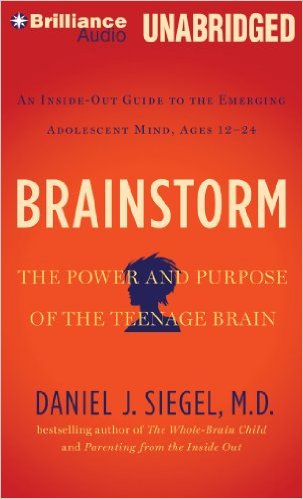
Brainstorm
The Power and Purpose of the Teenage Brain
by: Daniel J. Siegel, M.D.
Download AnnotationsPart I The Essence of Adolescence
3- Adolescents still benefit from relationships with adults. The healthy move to adulthood is toward interdependence, not complete ‘do-it-yourself’ isolation.
6- Brain changes during the early teen years set up 4 qualities of our minds during adolescence: Novelty Seeking, Social Engagement, Increased Emotional Intensity, and Creative Exploration.
11- The essence of the adolescent brain changes that are the essence of healthy ways of living throughout the life span spell the word essence itself: ES- emotional spark, SE-social engagement, N- novelty, CE- creative exploration.
13- When navigated well, these brain changes can lead to postive outcomes later on.
16- If adults fight against these fundamental features of adolescence, it’s like fighting the natural push of a waterfall.
22- The period from age 12-24 is the most dangerous times of our lives….Our challenge is to engage and explore ways to push at life’s boundaries without driving 100 mph down a public street. ….there must be some culturally sanctioned rites of passage we can reinvent….
24- If you as an adolescent begin to grasp the science behind the changes in your brain during your teenage years, your adolescence and adulthood will be better
29- Without adults around, young adolescents can literally go wild (elephant video)
34- High School is the ultimate testing ground for such balancing acts of relationships, tests of attachment to us and new attachments to friends.
37- By saying what is going on inside our own minds, we could listen closely to the other’s inner life and the intention behind it. That’s reflective conversation. Without such reflective dialogues with one another, the experience of these years would have been so different.
39- The changes during adolescence are not something to just get through; they are the qualities we actually need in order to live a full and meaningful life in adulthood.
40 Mindsight includes 3 fundamental skills- Insight, the ability to sense your own inner mental life; Empathy, the ability to sense the inner mental life of another person; and Integration, the ability to link different parts of something into an interconnected whole.
44- As we practice mindsight skills, we activate the prefrontal circuits and help them grow stronger. The brain changes its connections in response to experience. And experience here means how you focus your attention.
45- What is the mind? (for siegel) The mind is a regulatory process that is self- organizing in that it enables us to sense and shape how energy flows within us and with others.
47- Mindsight skill: SIFTing the mind- what am I sensing? what images come up? What am I feeling? What are my thoughts?
48- Focusing the mind can change the structure of the brain no matter our age
54- Focusing on non-verbal signals is an important way of turning on these circuits
56- When integration of different elements does not occur, our system moves toward rigidity or chaos
Part II: Your Brain
67- There is an increased reward drive in the adolescent brain- which may explain why teens may report a feeling of being ‘bored’ unless they are engaging in some stimulating and novel activities.
67-9- The increased reward drive manifests in 3 ways. One is simply impulsiveness. A second way is an increase in our susceptibility to addiction. A 3 rd type is something called hyperrationality- it is not a lack of thought or reflection, but a cognitive process that comes from a brain calculation that puts a lot of weight on the positive outcomes and not much weight on the possible negative results. This can be activated especially when teens hang out with other teens or believe their friends will somehow observe their actions.
75- The positive bias of hyperational thinking helps adolescents take on risks that they’ll need to embrace if they are to leave the nest and explore the world.
80-1- The moste effective strategy to get adolescents to avoid smoking was not offering teens medical information or trying to frighten them. It was to inform them about how the adults who owned the cigarette companies were brainwashing them to smoke so they could get their money. Encouraging the reflection on values and on gut instinct, not simply the inhibition of impulses, is the difference between turning down a compelling impulse and embracing a thoughtful belief and value.
82-3. Two fundamental changes- pruning and myelination- help the adolescent brain become more integrated.
89- 91. This “remodeling” of the brain means that areas of the brain will become more specialized and then interconnected. As teens we become more aware of ourselves and to think about life in conceptual and abstract ways. Even the ability to reflect on our own personalities emerges during the years of adolescence. Rather than the concrete ways of thinking and the fact-based learning that dominates during the elementary school years, the learning curve for us as teens involves a focus on more complex concepts. Our literal experience of being aware of life explodes. This knowing that we know emerges first in adolescence.
105- The prefrontal region of the brain maps the social world.
107- Brain scans reveal that when teens are shown a neutral face, they use the amygdala rather than the prefrontal cortex- they experienced it as aggressive.
Part III – Your Attachments
p. 145 “Human attachment can be understood as involving four S’s. We need to be seen, safe, and soothed, in order to feel secure….These ways our attachment figures treat us give us a sense of a safe harbor in which we can feel secure. But attachment relationships also serve as a launching pad from which we can take off and explore the world.”
Throughout this section he talks about different models of relationships- the secure model, the avoidant model, the ambivalent model, the disorganized model
p. 152 “Let’s highlight again here that your attachment model is a summary of how you’ve adapted to the relationships you’ve had with important people in your life. It’s not, however, a sign of some problem inside of you- it’s merely a reflection of a learned response to real-life events, to your actual relationship in your early days.
p. 170 “….this view suggests that integrated communication stimulates growth of integration in the brain. Non-integrated communication leads to non-integrated brain development.”
The fundamental take-away from here is that relationships and connections impact how we create relationships and connect- which informs our treatment of everyone we come in contact with.
Part IV – Staying Present Through Changes and Challenges
p. 215 As adults supporting adolescents are goal should be to be receptive and responsive rather than reactive- to connect rather than correct. The key quality of a relationship is to be present. The PART we play is- be present, be attuned, resonate, and create trust.
p. 227 “after 90 seconds an unimpeded emotion will begin to transform on its own.”
p. 239 He talks about the different kinds of love: Romantic (you are in love with someone), Sexual (you love making love together), and Attachment (you love being around this person). Getting these in one individual = Jackpot.
p. 241 “There is an important maturation during adolescence that requires a freedom of emotional life, thinking, planning, and plain old self-discovery that committed relationships can sometimes curtail.”
p. 252 “Studies of temperament, for example, reveal that the ultimate developmental outcome for children is not in what temperament the child has, but how accepting the parent is to that child’s individual characteristics.”
p. 262 “As the drive to explore new ways of experiencing reality emerges during adolescence, the use of drugs that alter brain function can be very intriguing.”
p. 263 “….baseline levels of dopamine during adolescence are actually lower. What this means is that teens may be prone to feeling “bored” unless they are engaging in novelty-seeking behaviors.”
Mindsight Tool #4 – The Mindsight Simple Seven
The brain changes based on experience- neuroplasticity. SNAG- stimulate neuronal activation and growth with The Healthy Mind Platter: Time-in, Sleep Time, Focus Time, Downtime, Playtime, Physical Time, Connecting Time. Conclusion – MWe and the Integration of Identity
p. 301 “….the more individualized and isolated our sense of self is, the less happy and less healthy we’ll be.”
p. 304 “It reminds us that our minds emerge as much from our bodies and brains as from our relationships with one another and with our planet.” “….these second dozen years of life-whether we are in them now or are learning to hold on to their essence in our lives-carry the core qualities that just may be what we need to move the course of our planet’s health in a positive direction.”
EB White: “If the world were merely seductive, that would be easy. If it were merely challenging, that would be no problem. But I arise in the morning torn between a desire to improve the world and a desire to enjoy the world. This makes it hard to plan From Fablehaven: Keys to the Demon Prison Seth selected a cue for himself. “Do we have a chance of succeeding?” Bracken chalked the tip of his stick. “Not much. But I’m not willing to let the
world end without a fight so I can keep playing ping-pong.”
p. 305 “….perhaps we can simply think of serving the world, of helping the planet and other people one relationship and one interaction at a time.”
p. 306 “….our integrated approach: Savor and serve. Integrating our lives is about differentiating and linking these two goals that, though in many ways are separate, contribute to a full life of enjoyment and connection, pleasure and purpose. We can enjoy ourselves and one another; we can have fun and explore this life, this world, these relationships. And we can find ways to help others, to reduce suffering, to heal our planet. Savor and serve. MWe can help us achieve this balance.”