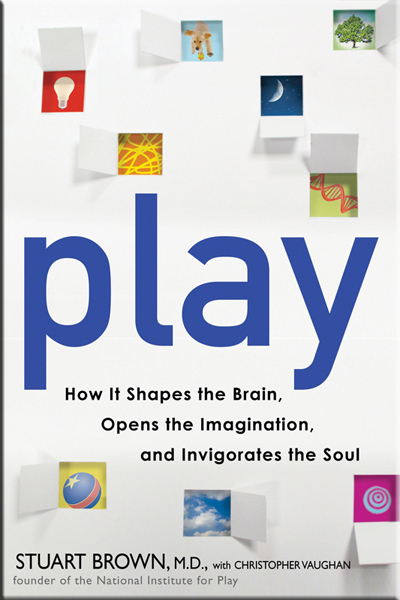
Play
How it shapes the Brain, Opens the Imagination, and Invigorates the Soul
by: Dr. Stuart Brown
Download Annotations-
Play has” evolved over eons…to promote survival.” “It shapes the brain…fosters empathy and makes possible complex social groups.” “lies at the core of creativity and innovation” “Of all animal species, humans are the biggest players of all. We are built to play and built through play.” (p. 5)
Play histories- how do you play?
Hiring at JPL engineering, found they were asking the wrong questions about resumes, etc. What they were really looking for were kids who had played with stuff as a kid- took things apart, etc- this was the key to success and innovation (p 10-12)
Play is a primal activity. It is preconscious and preverbal- it arises out of ancient biological structures (p. 15)
He defines properties of play: (p 17)
- Apparently purposeless (done for its own sake)
- Voluntary
- Inherent attraction
- Freedom from time
- Diminished consciousness of self
- Improvisational potential
- Continuation desire
In a study of murderers in Texas prisons, absence of play in childhood “was as important as any other single factor in predicting their crimes.” (p. 26)
When asking a field biologist why polar bears play…. His response “in a world continuously presenting unique challenges and ambiguity, play prepares these bears for an evolving planet” (p. 29)
“Play lets animals learn about their environment and the rules of engagement with friend and foe.” (p. 32)
“In humans, verbal jousting may take the place of physical rough-and-tumble play” (p 32)
“Animals that play a lot quickly learn how to navigate their world and adapt to it. In short, they are smarter” (p. 33)
“Play seems to be one of the most advanced methods nature has invented to allow a complex brain to create itself” (p. 40)
“play is a biological drive” (p. 41)
“As adults, the brain is not developing as rapidly and the play drive may not be as strong, so we can do well enough without play in the short term.” (p. 43)
idea of “play deficit” (p. 43) play deficit disorder?
“A singular characteristic of humans is that we stretch our juvenile period out longer than any other creature” (p. 50)
Neotony (retaining juvenile qualities as an adult) is a boon to humans…We are designed by nature and evolution to continue playing throughout life (p. 58)
“Play is a state of mind, rather than an activity” (P. 60- his emphasis)
We all fit, as our primary mode of playing, into one of eight play personalities:
- The Joker- not the batman guy
- The Kinesthete- likes to move, not necessarily for competition
- The Explorer- can be physical or mental
- The Competitor- loves the rules, plays to win- could be business
- The Director- born organizers- enjoy planning, executing scenes and events- can turn manipulative
- The Collector- of whatever
- The Artist/Creator- joy in making things
- The Storyteller- imagination is their kingdom of play
When we stop playing, we stop developing (p. 73)
Ways kids play: body and movement play, object play, imaginative play, social play, friendship and belonging, rough and tumble play, celebratory and ritual play, storytelling and narrative play, transformative-integrative and creative play (p 80-94)
“Play isn’t the enemy of learning, it’s learning’s partner.” (p. 101)
We may think we are helping to prepare our kids for the future when we organize all their time….but we may be taking from them the time they need to discover for themselves their most vital talents and knowledge. We may be depriving them of access to an inner motivation … (P 105)
The self that emerges through play is the core, authentic self (p. 107)
“In the end, the goal of adolescence is not only to acquire the skills to thrive in a world in which we are mutually dependent, but also to acquire a sense of individuality and uniqueness.” (p. 109)
thinks many of us suffer from “play deprivation” (p. 112)
“The opposite of play is not work- the opposite of play is depression.” (p. 126)
“Our inherent need for variety and challenge can be buried by and overwhelming sense of responsibility.” (p. 126)
I would claim that sustained emotional intimacy is impossible without play (p. 158)
Chapters on Play at work, play at work, play in adult life- I’ve skimped on these notes..
Does play have a dark side?
Addiction to video games…
“What some call the ‘dark side’ of play is actually an assortment of cases in which play is being used to deal with difficult emotions or when people are not really playing at all” (p. 178)
When someone is domineering, aggressive, or violent, they are not engaged in true play (p. 180)
We live in a ‘cephalocentric’, unbalanced world
The hand and brain coevolved and are closely dependent on each other (p. 184)
“A lack of play should be treated like malnutrition- it’s a health risk to your body and mind.” (p. 215)