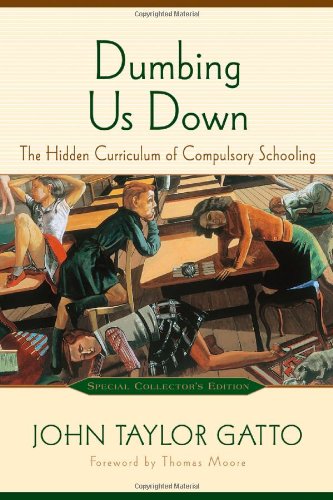
Dumbing Us Down
The Hidden Curriculum of Compulsory Schooling
by: John Taylor Gatto
Download Annotationsp. Xiv “Over the years, I have come to see that whatever I thought I was doing as a teacher, most of what I actually was doing was teaching an invisible curriculum that reinforced the mythos of the school institution” (my emphasis)
p. 1 I don’t teach English, I teach school.
The 7 lessons of school, “universally taught” (pages 2-12):
- Confusion- Everything is out of context. I teach disconnections. Meaning, not disconnected facts, is what sane human beings seek. I teach you how to accept confusion
- Class Position- You come to know your place. If I do my job well, they can’t imagine themselves anywhere else because I’ve taught them how to envy and fear the better classes and how to have contempt for the dumb classes.
- Indifference- I teach children not to care too much about anything. When the bell rings, I insist that they drop whatever it is we have been doing and proceed quickly to the next work station. Nothing important is ever finished in my class. The lesson of bells is that no work is ever worth finishing.
- Emotional Dependency- By stars and red checks, I teach kids to surrender their will. I intervene in many personal decisions, issuing a pass for those I deem legitimate.
- Intellectual Dependency- Good students wait for a teacher to tell them what to do. It is the most important lesson, that we must wait for other people, better trained than ourselves to make the meanings of our lives. Successful children do the thinking I assign them with a minimum of resistance and a decent show of enthusiasm.
- Provisional Self-Esteem- A kid’s self-respect should depend on an expert opinion. A monthly report is sent home to mark exactly, down to a single percentage point, how dissatisfied with the child a parent should be. Self-evaluation is never considered a factor.
- One Can’t Hide- Students are always watched. I assign a type of extended schooling called ‘homework’ so that the effect of surveillance travels into private households where students might use free time to learn something unauthorized from a father or mother.
p.12 It is the great triumph (of schooling) that only a small number can imagine a different way to do things
p.13 “Reading, writing, and arithmetic only take about 100 hours to transmit as long as the audience is eager and willing to learn. The trick is to wait until someone asks and then move fast while the mood is on”
p.14 School takes our children away from any possibility of an active role in community life
p. 19 It is time we squarely face the fact that institutional schooling is destructive to children. Nobody survives the 7 lessons of schooling completely unscathed. No tinkering will fix it.
p.20 (His Solution) A ‘free-market’ system of education “in which students volunteer for the kind of education that suits them, even if that means self-education” (later in book he talks about the Congregational Model where people voluntarily gather themselves into harmonious groups)
p.20 I believe the method of mass schooling is its only real content.
p.21 The lessons of school prevent children keeping important appointments with themselves and their families.and to learn lessons in service. Thirty years ago these lessons could still be learned in time after school. But TV has eaten up most of that time. Our kids have no time left to grow up fully human.
p. 24 We live in networks, not communities, and everyone I know is lonely because of that.
p. 25 Although teachers do care and do work very hard, the institution is psychopathic.
p.26 The school institution ‘schools’ very well, although it does not educate.
p.28 Two institutions at present control our children’s lives: television and schooling, in that order. In centuries past, the times of childhood and adolescence would have been occupied in real work, real charity, real adventures, and the realistic search for mentors who might teach you what you really wanted to learn.
p. 33 More money and more people pumped into this sick institution will only make it sicker. We need to rethink the fundamental premise of schooling and decide what it is we want children to learn and why.
p. 34 Self knowledge is the only basis of true knowledge. We have to invent school experiences that give that time (for self knowledge) back.
p. 35 Independent study, community service, adventures and experiences, large doses of solitude and privacy, a thousand different apprenticeships, these are all effective and cheap ways to start a real reform of schooling. Include family as the main engine of education.
p. 68 Eventually, you have to become part of a place…Discovering meaning for yourself, and discovering satisfying purpose for yourself is a big part of what education is.
p.75 What’s gotten in the way of education in the US is a theory of social engineering that says there is one right way of growing up.