
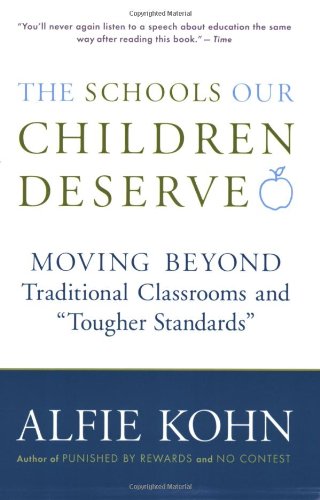
The Schools Our Children Deserve
Moving Beyond Traditional Classrooms and "Tougher Standards"
by: Alfie kohn
Download Annotations2- “Traditional schooling turns out to be as unproductive as it is unappealing”
3- Larry Cuban, educational historian, points out ‘basic ways of schooling children have been remarkably durable over the last hundred years’
9- “look at the middle school movement, a long-overdue attempt to turn the hell that is junior high school into a more supportive, developmentally appropriate place for young adolescents. Today, that movement is on the defensive as champions of the Old School succeed in their quest for ever-tougher standards”
The Problem: our beliefs in motivation, teaching/learning, evaluation, school reform and improvement
Motivation: the overemphasis on achievment
25- are you more interested in what you’re teaching than in what students are learning?
26 “It is the student’s point of view- specifically, a psychologically informed understanding of that point of view- that determines whether real learning will happen”
“thoughts and emotions while performing an action are more important in determining subsequent engagement than the actual outcome of that action”
28-“performance goals may well create the very conditions that have been found to undermine intrinsic interest…assuming it’s important to us that our children become lifelong learners, we have good reason to be concerned if too much attention to boosting achievement during school can make the whole idea of learning seem like a chore.
29- “If the point is to succeed rather than to stretch one’s thinking or discover new ideas, it is completely logical for a student to want to do whatever is easiest”
31- “the problem, in other words, isn’t with the individuals, their effort or attitude, so much as with the system in which they find themselves”
32- “’Learning goals will lead to better task outcomes than will performance goals’…The more that real thinking was required, the worse the results for kids who were concerned about high achievement”
38- “Winners and losers alike are made to think they’re competent and valuable only to the extent they’ve defeated others”
41- “In short, what grades offer is spurious precision- a subjective rating masquerading as an objective evaluation.”
43- ” “Grading, in other words, relieves educators from having to rethink what and how they are teaching. It’s always the kid who is said to have ‘earned’ an A or F.”
44- “the available research suggests that celebrating a good report card helps to shift children’s goals in an unproductive direction.”
Teaching and Learning wrong; traditional education and its victims
47- “The result of grade-by-grade standards, with their willful disregard of individual difference, is that some children will be branded as failures because they don’t learn as quickly’
51-53 An analogy of learning reading to driving: do we isolate the skills of driving?
54- “studies have demonstrated that we memorize best when we analyze what we are learning, find patterns in it, and relate it to knowledge we already have…when we think about it.”
58”’Posing narrow questions for which one seeks a singular answer denies teachers the opportunity to peer into students’ minds”’
59 Textbooks “include a little bit of everything and a thoughtful treatment of nothing”
60 Howard Gardner refers to coverage as the single greatest enemy of understanding
63 Teaching is “an interactive practice that begins and ends with ‘seeing’ the student”
68 We should not pursue disciplines, but interesting questions or interdisciplinary subjects
The combined list of our standards makes “the scope of…requirements ludicrously unrealistic”
67-69 We separate subjects, disciplines, students, tasks, and we separate learning from doing (our value system, but There is no such thing as a value free classroom)
Evaluation as wrong: No standardized testing
75 Standardized tests are ‘destructive, because it can change (education)…for the worse”
77 The problem with ‘norm-referenced tests’- that majority of states use these- they “find out how well your child does compared to every other child taking the test” reporting percentiles
80 Tests “seem to be measuring…how much a student has crammed into his short term memory”
83 “’I don’t think there’s any way to build a multiple-choice question that allows students to show what they can do with what they know”
84 Tests offer” ‘one of the few levers on the curriculum that they can control”…the tail of testing is now wagging the educational dog
90- “excitement about learning pulls in one direction; covering the material that will be on the test pulls in another”
Getting School Reform Wrong: The Arrogance of Top-Down Coercion
95 Much discussion of Taylor’s early 1900’s movement to ‘effieincy’ both in testing and in school reform- “an outmoded, top-down model of control”
96 When teachers feel pressured to produce results, they in turn pressure students. It creates a climate of fear, anger, and resentment
97 It is based on a fundamental flaw: ther is one entity called ‘motivation’
98 Extrinsic motivation is corrosive, intrinsic is not
Getting school improvement wrong: more of the same
103 more time (longer school day, year, classes) doing the same stuff isn’t better
104: More homework ‘doesn’t help at any age’ but may cause poorer attitudes in students
105 Research indicates tracking, holding people back, etc don’t work
106 harder work isn’t better, it is best to find “optimal difficulty, not maximum
110 School work should have- context, skills and meaning
111 Deborah Meier’s: “No student should be expected to meet an academic requirement that a cross section of successful adults in the community cannot”-his italics
Part two- For the love of learning
120 “my own vision of schooling…is defined by a concern for both the fulfillment of each child and the creation of a more democratic society”
127 “if we want kids to learn for the right reasons, then the content and method of the instruction become directly relevant”
128 “where interest appears, achievement usually follows” (his italics)
129 The students have to experience the lesson as relevant. Relevance is constructed
130”The goal is to create a learning experience that arouses and sustains children’s curiosity, enriching their capacities and responding to their questions in ways that are deeply engaging”
132 “humans are by nature meaning makers”, “the source of intellectual growth is conflict”
135 Consider: do you have everyone use a ruler or do you have them invent the ruler?
137 Direct instruction “should occur after students have had the chance to explore”
141 Consider the following: which is larger 4/11 or 5/13? The correct answer is: who cares?
142 students need tasks that require interpretation, involve uncertainty
145-50 Start with a question, a problem, or a project
Students need authentic decision making… generating possibilities, not just choosing from a list
150 “Perhaps no other principle in our society is at once so commonly endorsed and so rarely applied as the value of democratic participation”
153 America has an ‘exaggerated individualism’ that makes us ignore the interactions that others play in our understandings
156 “I see an example of classroom learning … that is collaborative, interdisciplinary, project-based, dedicated to discovery, animated by student decision-making, and grounded in the construction of meaning” my emphasis
Rest of the book discusses more concretely the 3R’s and specific literature.