
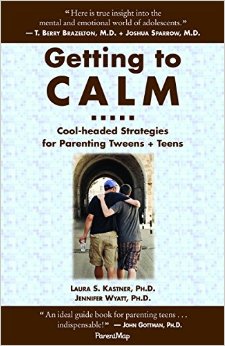
Getting to Calm
Cool-headed Strategies for Parenting Tweens + Teens
by: Laura S. Kastner, Ph.D. & Jennifer Wyatt Ph.D.
Download AnnotationsThis book give various scenarios and possible response for handling situations. The
section on the teen brain and love/relationships/sexuality was insightful. Major themes:
1) Be an engaged parent ABC’s of family Health: p 258-259.
2) Remain calm (C-Cool Down A-Assess options L-Listen with empathy M-Make a plan)
3) Be prepared: Parents do have a bigger influence than we think during the teen years
4) Brain development and the teen (protecting the brain (avoiding drug use),
assist/support teens through their relationships, and work to develop their social and
emotional competence).
Balance important: (p.4) “Although clear in their authority, there’s ongoing give and take
with the teen…A useful standard is five to one: Each negative interaction needs to be
balanced with five positive ones.” How to deal with rudeness? (understand it is
temporary It’s more about forming the self than parents realize when considering
hormones, brain development peers and demands/expectations) Ignore, address
directly, or diffuse.
Parenting styles Chapter 1: (Avoid extremes and seek middle ground – CAPS ideal)
Permissive…AUTHORITATIVE…Authoritarian
Low control…THOUGHTFUL CONTROL…Excessive control
Cold and disengaged…WARM & APPROPRIATELY ENGAGED…Enmeshed
Communication cutoff…EFFECTIVE COMMUNICATION…Unbounded talk
Brain changes p18: Massive reorganization of the brain. The prefrontal cortex
undergoes reconstruction. Over 1/2 of existing synapses are “whittled away in this
critical area for thinking, as new connections are rewired and the brain is ramping up to
become faster and more efficient once the process in completed.” resulting in increased
opportunity but also increased vulnerability in the teen. Just when they are getting
independence, their ability for good judgement is gone. “literally losing parts of their
mind.” p 19. While their ability to make clear judgements is decreasing, their emotions
are directing their actions more. To make best use of this development, “Teens need to
be interacting with people to develop social skills. They need to be out in the world,
engaging in a mix of extracurricular activities, and coping with and solving a range of
problems.”
VERY INTERESTING: Teens misread signs of emotions. “Shown a face, teens were
found to mistake looks of fear and surprise as anger and hostility. Brain images
revealed that the emotional part of their brains were lighting up during this test,
indicating that they were using this part of the brain to decode the facial
expression….the prefrontal cortex in teens has not yet developed to the point that it canrein in the intense reactions of the emotional part of their brains that’s screaming, “I
want what I want!” p20 “big engine (autonomy), poor driving skills (re-wiring of
prefrontal cortexes and emotional), faulty brakes (lack of impulse control), and high-
octane gas (intense emotions).” (p21)
Web Facts: Most all use to stay connected, less inhibited than face to face, most teens
say things on-line that they would not directly say. Abuse: most by people the kids
know, give too much information, 30% teen girls sexually harassed in chat rooms (only
7% tell their parents), 1/3 of all teens report threatening messages, private messages
forwarded, embarrassing picture posted without consent or having on-line rumors
spread. 70% of teens have accidentally come across pornography on the Web. pg 160.
Common, those youth seeking porn, less likely feel affection is necessary for sex and
those viewing sexual explicit images are more likely to see women as “playthings.”
Violent video games: “exposure to violent video games is a direct cause of aggressive
behavior, aggressive thinking, aggressive feelings, and cardiovascular
arousal…decreased helping behavior.” p 165. Similarly excessively violent TV viewing
resulted increased incident of violent behaviors. Violent games are teaching violence.
The Teen Brain in Love: The brain does react like it is on “drugs” the reward part of the
brain is activated. p 165 “sex and romance are related but separate issues.” remember
to have a talk about relationships rather than just the sex talk.
Things to try to avoid: minimize their feelings, overlook the value of the relationships,
being too involved, don’t assume it’s just about sex, but also pay attention to when it is
getting more and more intimate, avoid being overly inclusive of the person they are
dating. Do: maintain a balanced healthy relationship with your teen. p170 “the quality of
the attachment between parent and child influence the quality of teens’ dating
relationships, which, in turn, influence teen’s capacity for long-term, committed
relationships.” The teens need to feel supported and secure.
Puberty: “A parent’s job is to take the lead in supplying teens with copious information
about what’s happening to their bodies, whether it be menstruation, breast
development, genital growth, or nocturnal emissions. Get books, sign up for classes
together and use every possible natural opportunity to reassure teens that what they’re
experiencing and feeling is a normal part of human development.” p 187. Educate what
is going on with both girls and boys.
Talking to Teens about Sexuality: “experts estimate that parents are two years behind
where their teens need them to be with regard to sex education. Only one out of three
parents of sexually active 14-year-olds realizes that their child has had sex……A
position paper from the Society for Adolescent Medicine recommends that teens should
have the human right to information about their sexual health…..teens need sexuality
education that teaches them refusal and negotiation skills…”(p 189). “Children whose parents talk with them about sex have no increased rates of sexual activity. And when
they do become sexually active, they’re more responsible about practicing safe sex.
Research shows that teens with the most connected relationships with their parents
have the most responsible sexual behavior, including delaying intercourse, being less
promiscuous, and practicing safe sex.” p 189. An open, honest and consistent
communication pattern is the best. Interesting list of responsibility important for youth
choosing to engage in sexual activity: pg 198-200.